
Louise Glück: Indelible Fingerprints at Steven Harvey Fine Art Projects on October 20-November 28
Presented in collaboration with James S. Jaffe Rare Books and Garvey Rita Art & Antiques
Louise Glück: Indelible Fingerprints
October 20-November 28, 2026
Steven Harvey Fine Art Projects
208 Forsyth Street
New York, NY 10002
Louise
Glück (1943–2023) began writing poems at the age of five and never
stopped. She studied at Sarah Lawrence and had taken night classes at
Columbia with the poets Leonie Adams and Stanley Kunitz, though she left
both schools without earning a degree. A major postwar American poet
without an MFA in creative writing or even a college degree. Despite
lacking academic credentials, she received many literary awards and
honors, including the National Book Critics Circle Award (1985), the
Pulitzer Prize (1993), the National Book Award (1993), and the Nobel
Prize (2020). Although internationally celebrated for her poetry, she is
not known for her art. Still, Glück valued her early, small body of
work enough to include eleven examples in her archives, now held at the
Beinecke Rare Book and Manuscript Library at Yale University. This
exhibition presents eight additional paintings which were held by her
family and will be seen in public for the first time. A catalog with an
essay by the noted critic/poet John Yau will be available.
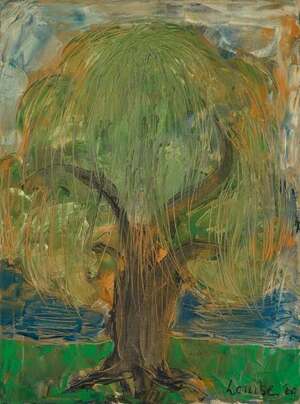
Untitled, 1960
oil on board
24 x 18 inches
Image Copyright the Estate of Louise Glück
Brimfield's Heart-O-The-Mart at Art Tent on September 9
Carl Ashby, painter and printmaker, was
born in Hurley, New Mexico on March 2, 1914. He worked as an artist for
the Civilian Conservation Corps before attending the University of Utah,
where he received his degree in 1937. He relocated to New York City
shortly thereafter and married artist Estelle Grey in 1938. Ashby worked
at Atelier 17 sometime between the years 1940 and 1955, and earned his
MA degree from New York University in 1959. He taught at the Parsons
Division of the New School at New York University for twenty-five years
beginning in 1970. During his career, Ashby studied with artists Hans
Hofmann, George Grosz and Morris Kantor. His works and papers are
included in the permanent collections of the Smithsonian Archives of
American Art, the Provincetown Art Association and Museum, and the Hood
Museum at Dartmouth College.
Downeast Art & Antiques Show on August 12-15


Laurence Sisson (1928-2015)
Maine Coast
oil on board
30 x 22 inches
The Newport Show on July 25 & 26


Patrick George (1923-2016)
Garden Gateway, 1994-98
oil on panel
13 3/4 x 40 inches
Acquired
from a William Hodgins designed home in East Hampton, NY. Hodgins
acquired it for his client directly from Browse & Darby, George's
longtime dealer in London. Patrick George was a landscape and figure
painter of distilled emotion and intelligence. A modest man of
considered opinions and dry humour, he preferred to paint at his Suffolk
home rather than court the art establishment, and his visits to London
were mostly made in order either to teach or to see exhibitions of other
artists’ work. He eschewed self-promotion, yet his paintings are much
cherished by a growing band of admirers who appreciate the formal
toughness, unusual structures and sensitive colours of his subtle
approach. Chief among his artist supporters was Frank Auerbach, who has
described George’s painting as having “the tension of a tightrope
walker. I find it engrossing and admirable.” George was at the center of
20th century British painting; a student and then colleague of William
Coldstream at the Slade, a contemporary of Lucian Freud and a mentor of
Euan Uglow. He was celebrated for his devotion to the particularity of
things, especially trees, and English light and atmosphere, and his
ability to render all this most beautifully and memorably into the
language of paint. In later years he read Montaigne to help prepare
himself for death, but lost none of his relish for life, continuing to
paint and regularly enjoying roast lamb, good wine and whisky. His later
work was looser in application but none the less effective for this.


